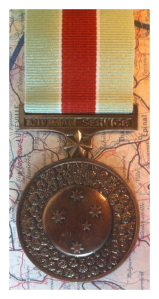
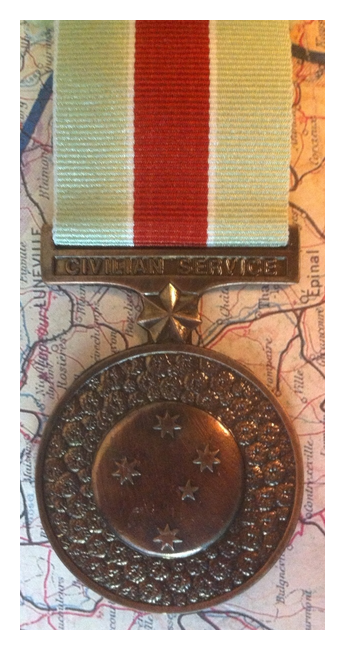
 The Civilian Service Medal 1939–1945 is awarded to civilians in Australia during World War II who served in arduous circumstances in support of the war effort as part of organisations with military-like arrangements and conditions of service. The medal was introduced in 1994, following a recommendation of the Committee of Inquiry into Defence and Defence Related Awards.
The Committee intended to extend recognition only to those whose war service in Australia was more arduous than the norm, and was performed under military-like conditions. Hence, Women’s Land Army members, whose work was very physical, required them to live in rural areas away from their homes for lengthy periods, and was subject to military-like discipline, are generally eligible. On the other hand, members of the industrial workforce involved in munitions production are not eligible, as they overwhelmingly lived at home and were subject to standard civilian working conditions. The medal is therefore recognition of those not in the armed services, but who experienced wartime working conditions similar to the armed services.
Recipients must have served for at least 180 days in any one or a combination of the 38 eligible groups between 3 September 1939 and 2 September 1945. Recipients of the Civilian Service Medal 1939–1945 do not earn an entitlement to use post-nominal letters. As at 30 June 2006, 6,711 awards of the Civilian Service Medal 1939–1945 had been made.
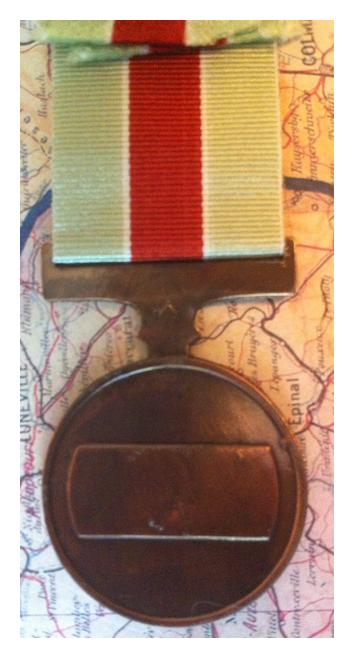
This particular example is blank on the reverse and therefore unissued stock.


 A couple of cool and evocative finds here from a contact in Thailand. These are Thai 1940 dated railway spikes from the ruined railway line that ran over 415 km from Thanbyuzayat in Burma to Ban Pong in Thailand. Many people know it only from it’s depiction in the movie “The Bridge on the River Kwai” where it crosses the Mae Klong river. I visited the site and Hellfire Pass in 2014 and I cannot believe the misery under which the slave laborers, both civilian and Allied POW, must have worked and died. A digger over there walked sections of the rail line that were never reused after the war and retrieved these spikes.





 Kiwi Medals