 This is a Walther PPK 7.65mm automatic pistol, manufactured in Germany by Walther in 1943 and issued as a police sidearm. The holster is marked Otto Sindel, Berlin, 1943. The two magazines are original to the pistol with matching serial numbers. The receiver and frame are marked Eagle N which indicates acceptance by the Wehrmacht post 1940 and the left hand side of the frame is marked with the Eagle and a C following, indicating police issue. This pistol was reputedly acquired in Normandy by a Lieutenant Stagg, adjutant of the Oxford Rifles, from the body of a German SS officer he had just shot. Well at least that’s the tale that came with it. However upon researching I discover that the Oxford Rifles didn’t get shipped to Europe until January 1945. This is not to say that Stagg could not have been in France in July 1944, just not as adjutant of the Oxford Rifles. This will provoke some further investigation.
Further snooping reveals a Major Kenneth Stagg, P38758, in the Oxford Rifles in 1945. He was born in 1899 which makes him 45 in 1944.
Remember Kids! Buy the item, not the story!


 Shrapnel and shell fragments accounted for a large proportion of those killed and wounded in WW1. Those blown into the ether by high explosive to one side, artillery accounted for around 70% of casualties. These six balls were recovered from the Thiepval Redoubt on the Somme and are German in origin. Thiepval was a slaughterhouse on the first day of the attack and, despite early success, took a savage pounding from German counter-fire.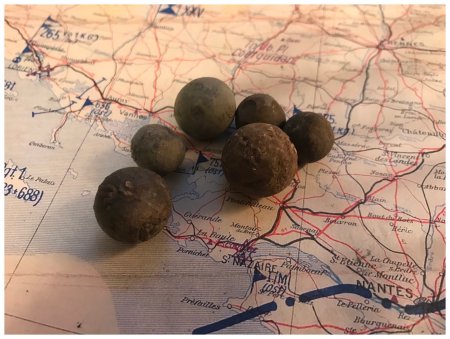




 Kiwi Medals