Archive for the Medals Category

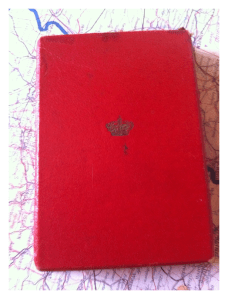
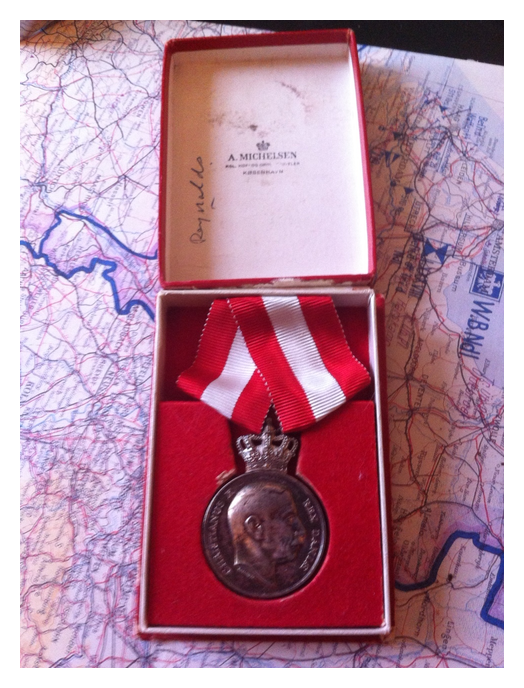
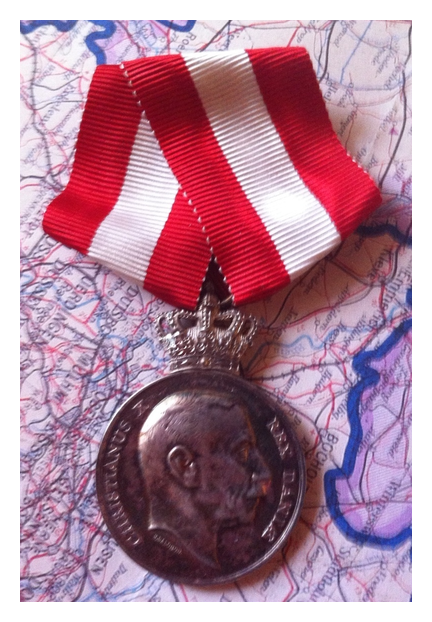
Denmark Pro Dania 1945 Medal with Case

Posted in 1939-1945 Service Medals, Rare Medals with tags , , , on April 16, 2013 by The Dude

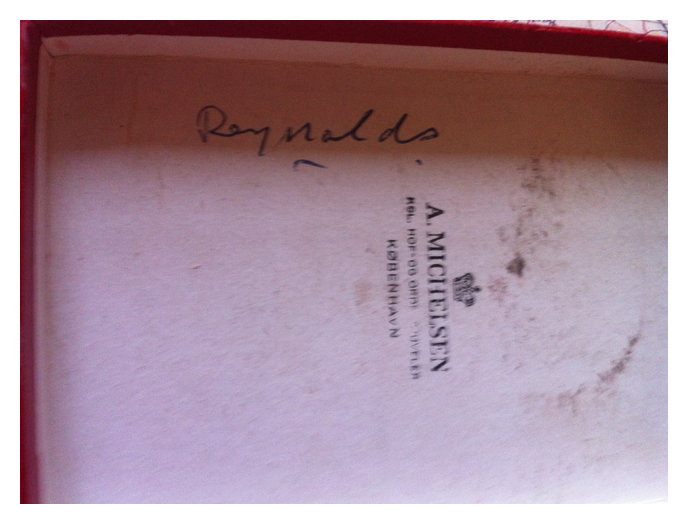
Flag_of_DenmarkThis medal was instituted on 5 May 1946 and bestowed on some 3,100 persons who had rendered special services to Denmark during the German occupation. This particular example is marked to the surname Reynolds on the inside of the case. When I look this up in the Danish “Hof-og Statskalender” the only Reynolds awarded this medal is Squadron Leader Reggie Reynolds CO of 139 Squadron RAF flying Mosquitos.

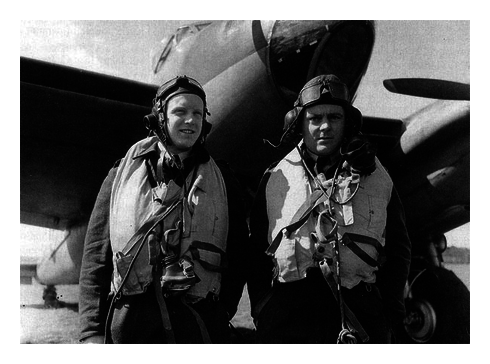
Flying with his long time navigator Sismore on October 31 1944 Reynolds led a force of 24 Mosquitos in a raid on the Gestapo headquarters lodged in the buildings of Aarhus University in Denmark. The surprise attack, in misty weather, was delivered from low level and was a complete success. The head of the SS was killed, one of his officers writing: “A terrible disaster happened when our HQ was shot up by English airmen.” For their outstanding leadership, both Reynolds and Sismore received a Bar to their DFCs.

First up a photo of Sismore (left) and Reynolds (right) in front of a Mosquito aircraft.
rsz_sismore_reynoldsrsz_denmark5

rsz_denmark4

rsz_denmark3

rsz_denmark2

rsz_denmark1

A Birchall Group from the Boer War

Posted in 1850-1900 Medals, Family Groups & Singles with tags , , on April 16, 2013 by The Dude
Flag_of_the_United_Kingdom

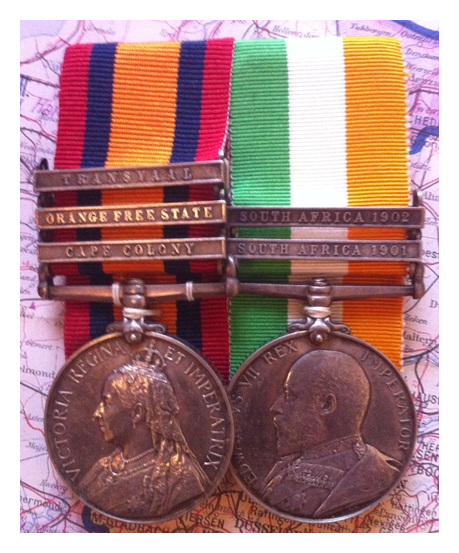
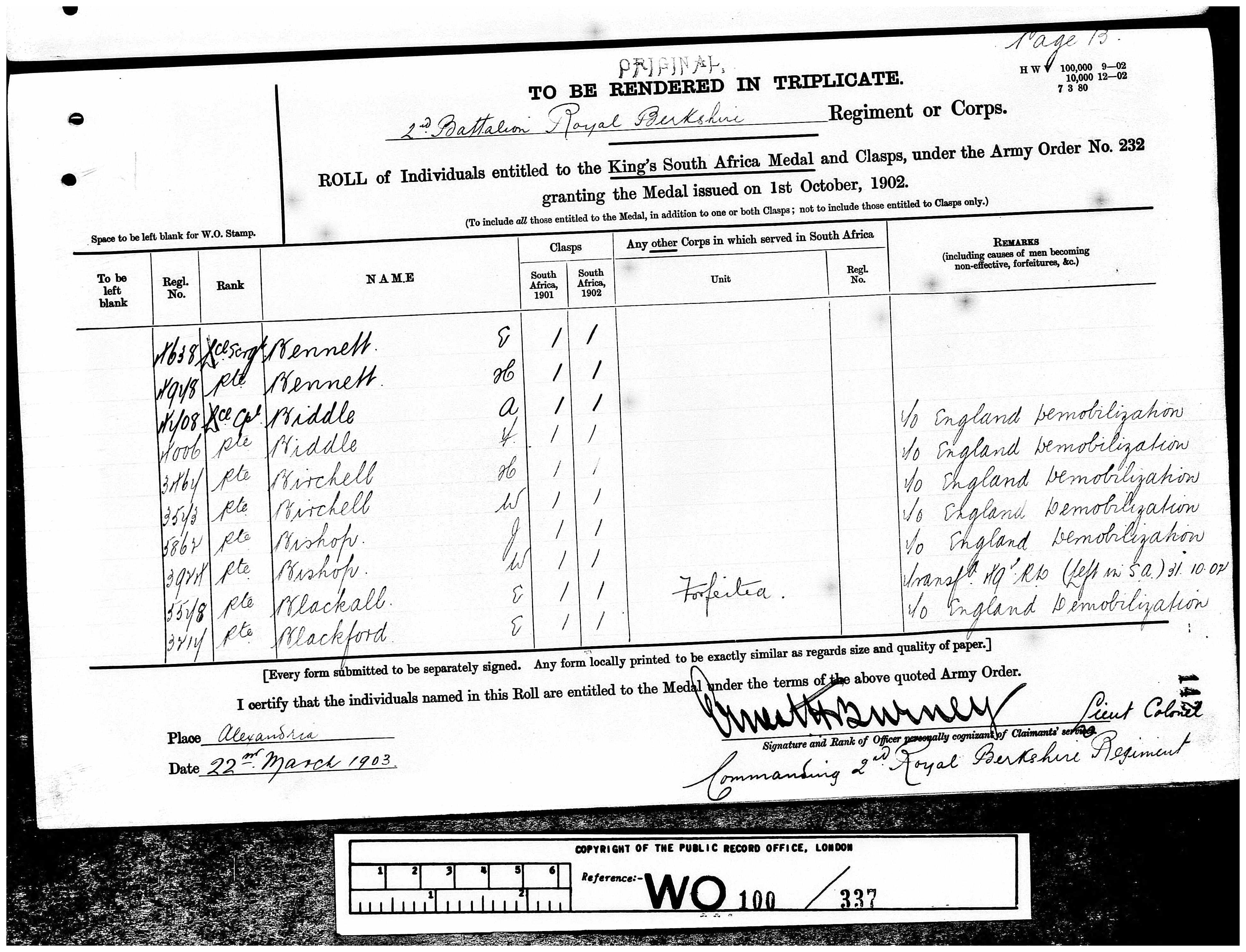
This is a group from my family consisting of the Kings South Africa Medal with South Africa 1901 Bar and South Africa 1902 Bar and the Queens South Africa Medal with Transvaal Bar and Orange Free State Bar and Cape Colony Bar. It is marked to 3573 W. Birchell RL: Berks Reg.

20 Year Commemoration of the Liberation of Romania from the Fascists

Posted in 1939-1945 Jubilee Medals with tags on August 1, 2011 by The Dude

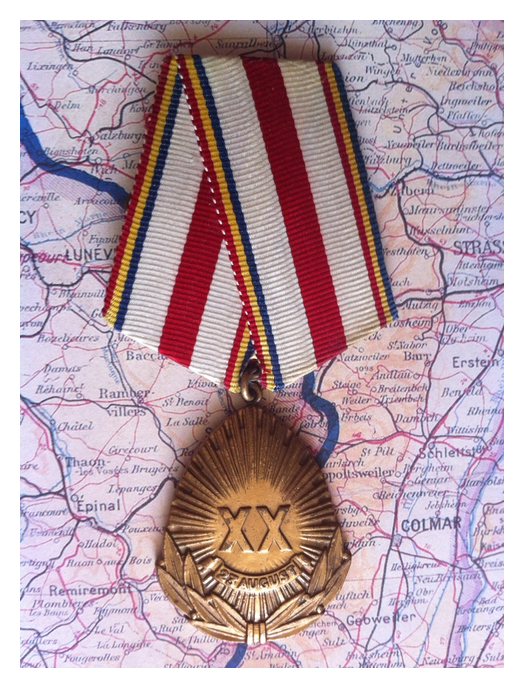
Flag_of_Romania_(1952-1965)This is yet another commemorative issued by the Communist government of Romania. It seems that all the Warsaw Pact countries continued to stamp out these medals at regular intervals. Perhaps to rub it into the West that they had played a large part in Germany’s defeat. As a side note, since the Romanians spent most of the war under the Axis perhaps this medal could also be described as commemorating 20 years of subjugation by the Communists?
rsz_romanian202 rsz_romanian201

Loyal Service Cross Type 2 Class 3 with Swords

Posted in 1939-1945 Service Medals with tags on August 1, 2011 by The Dude

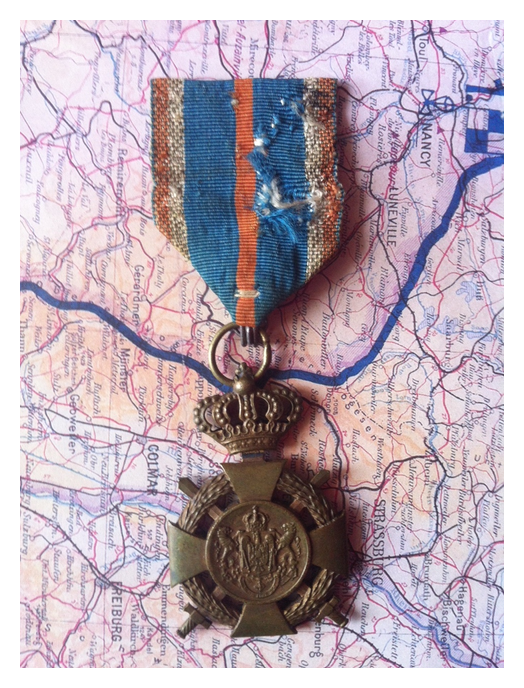
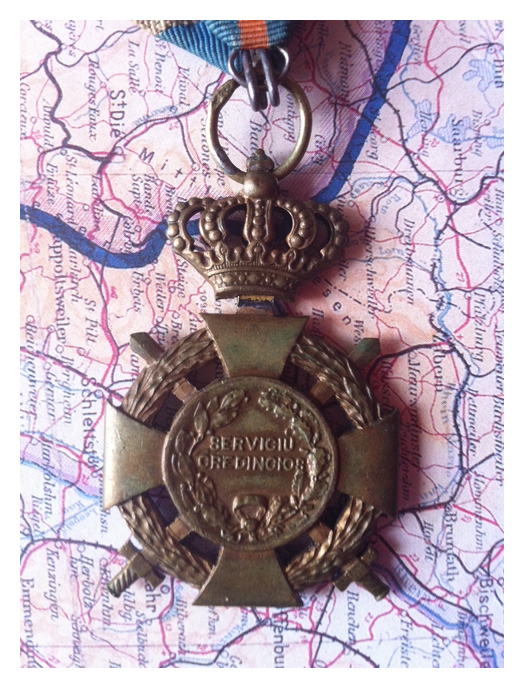
Flag_of_Romania_1948The Type 2 Loyal Service medal was awarded from 1932 to 1947. It was awarded in three classes. Class I was made in silver gilt, class II in silver, and class III in bronze. Beginning in 1937, the type 2 medal could also be awarded with swords to members of the military.
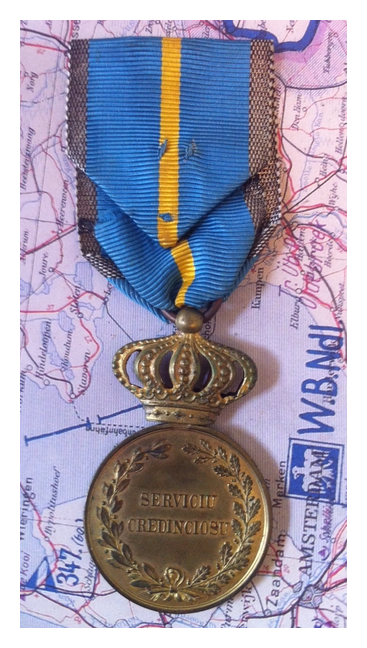
This example has the yellow bands to the ribbon on the edge indicating it was awarded during a time of war which puts it square into WW2.

The Obverse reads “Serviciu Credincios” (Translation: Loyal Service), surrounded with a wreath of laurel and oak leaves.

In all there were 8 variations of the medal.

rsz_romanianls2 rsz_romanianls1

WW2 Commemorative Cross

Posted in 1939-1945 Jubilee Medals with tags , on August 1, 2011 by The Dude

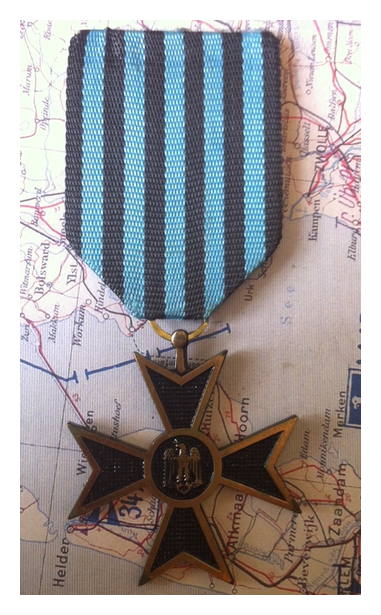
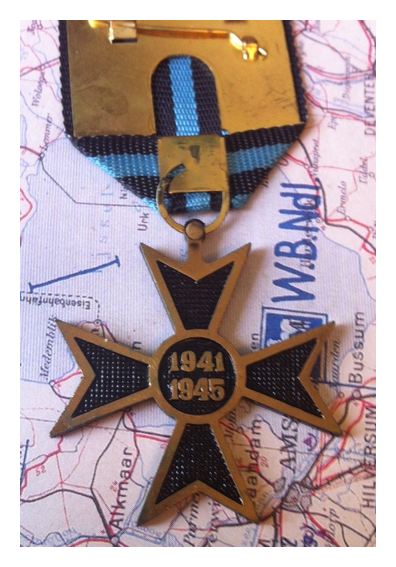
Flag_of_Romania_1948This medal is a post-Communist Romanian commemorative medal issued to all those who served in the Romanian Armed Forces during WW2. This medal actually similar in design to that produced after the First World War and is obviously intended to mimic it.

rsz_romcom1 rsz_romcom2

Medal for the Crusade Against Communism

Posted in 1939-1945 Service Medals with tags , on August 1, 2011 by The Dude

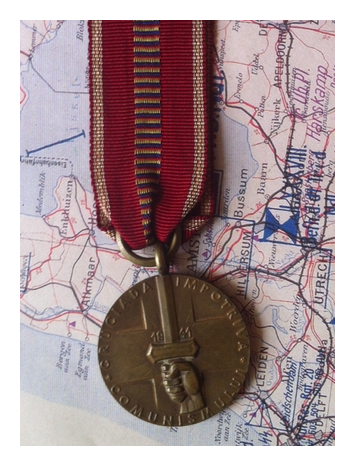
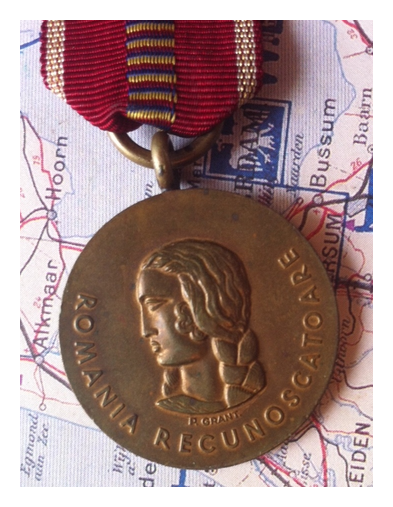
Flag_of_Romania_1948This medal was instituted by Royal Decree No. 1014 of April 1, 1942 and was awarded to military personelirrespective of rank as well as civilians who had distinguished themselves in the battles on the Eastern front. The medal could be awarded without bars, but the following bars were authorized: BUCOVINA, BASARABIA, DOBROGEA, NISTRU, ODESSA, BUG, NIPRU, AZOV, CREMEEA, DONET, MAREA NEAGARA.

The medal is dated 1941, and it was awarded through 1944. After 1944, Romania was occupied by the Soviets, and this award became obsolete. In fact if would have been very unhealthy to be found with this medal under the Communist regime that followed the War.

rsz_romaxis1 rsz_romaxis2

Medal for the Liberation From Fascist Subjugation

Posted in 1939-1945 Service Medals with tags on August 1, 2011 by The Dude

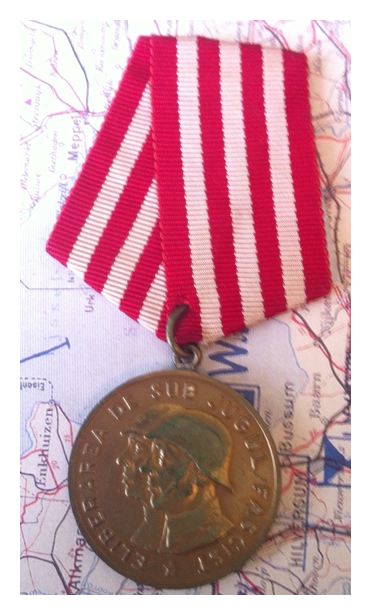
Flag_of_Romania_(1952-1965)This is a post-war commemorative medal from the Communist Romanian People’s Republic. The writing roughly translates as in the title of the post. Undoubtedly stamped out by the million.This medal was awarded in 1949 by the Communist Government to soldiers and civilians who participated in the ‘struggle’ against the Germans in World War II. While Romania was allied with Germany during most of the war, King Michael overthrew Marshal Antonescu (the defacto ruler of Romania) in 1945 and turned Romania’s forces against their former allies. Because there is also a medal awarded by Romania for fighting against Communism (see Crusade against Communism Medal), it is conceivable that some soldiers received both awards.

The medal is suspended by the distinctive communist tri-fold ribbon, and has four red and three white stripes in alternating fashion. The medallion depicts the bust of two soldiers, one Romanian and the other Soviet, side by side. The busts are encircled by the words; “ELIBEREA DE SUB JUGUL FACISTl” translation: Liberation from fascist subjugation.

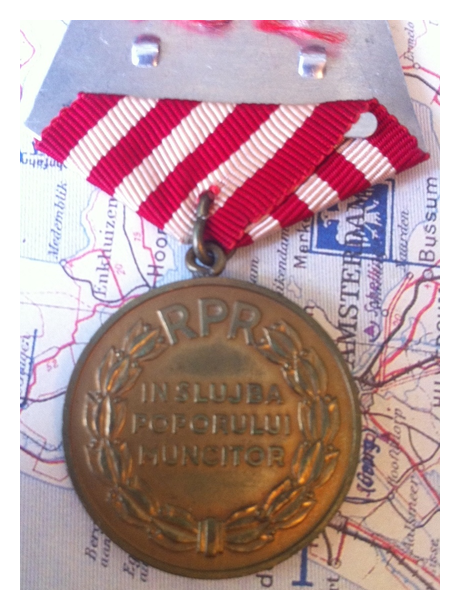
The reverse is comprised of a laurel wreath surmounted by the letters RPR encircling the words, “IN SLUJBA POPORULUI MUNCITOR”. translation: “Workng for the working people”.

rsz_romsov1 rsz_romsov2

Romanian Faithful Service Medal Class II

Posted in 1919-1938 Medals with tags , on August 1, 2011 by The Dude

Flag_of_Romania_1948This is the Faithful Service Medal issued under King Carol of Romania. This is the second class type without swords so it would be issued for non-war service, for example civil servants, postmasters, policemen and so on. It also has the non-warlike ribbon without the yellow edge stripes.

rsz_romservice2 rsz_romservice1

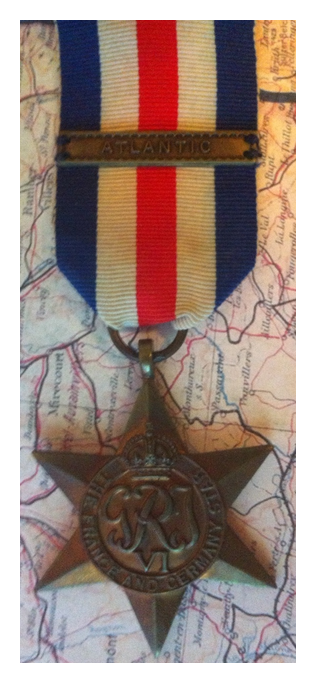
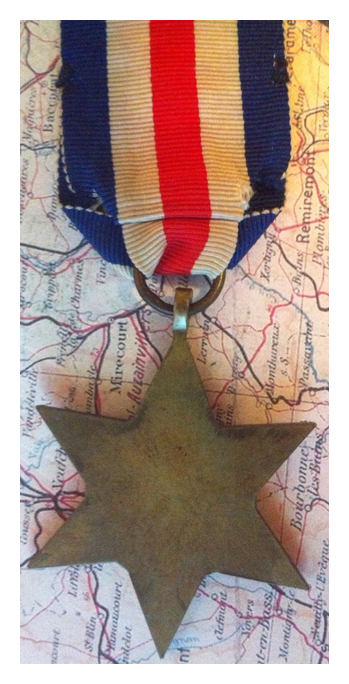
France & Germany Star with Atlantic Bar

Posted in 1939-1945 Service Medals with tags , on February 14, 2010 by The Dude

Flag_of_the_United_KingdomThis is my stock France and Germany Star, in this case only notable for the additional Atlantic Bar.

The France and Germany Star was a campaign medal of the British Commonwealth, awarded for service in World War II.
The medal was awarded for operational service in France, Belgium, Luxembourg, the Netherlands, and Germany from 6 June 1944 (D-Day) to 8 May 1945. The qualifying sea area is the North Sea south of a line from the Firth of Forth to Kristiansand (South), in the English Channel and in the Bay of Biscay east of longitude 6° west, provided such service was directly in support of land operations in France, Belgium, the Netherlands or Germany.

British uniform regulations stipulated that neither the Atlantic Star nor the Air Crew Europe Star would be awarded to a recipient of the France and Germany Star. Subsequent entitlement to the Atlantic Star was denoted by the award of the Atlantic clasp. A clasp for the Air Crew Europe Star was not issued as that Star could not be earned after 5 June 1944.

Army personnel who entered Austria may not qualify for this award, as their service is recognised by the grant of the Italy Star.

rsz_fgatlantic1 rsz_fgatlantic2

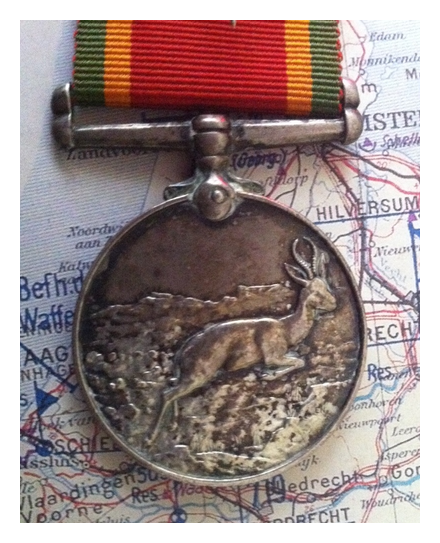
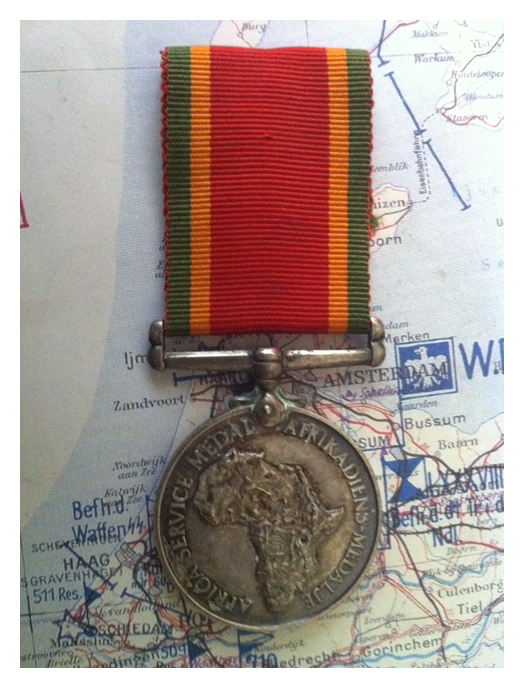
Africa Service Medal

Posted in 1939-1945 Service Medals with tags , on February 14, 2010 by The Dude

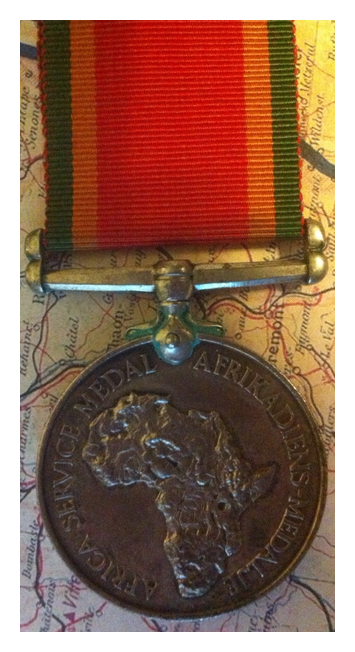
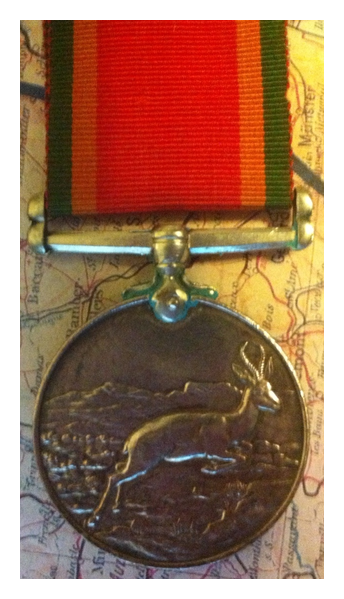
Flag_of_South_Africa_1928-1994I have three examples of this medal. The first is impressed to 313971 M.L. Schultz, the second to 156658 B.S. Tinderholm (I have his War Medal also) and the third to 572811 J.Daitsh.

The Africa Service Medal was a South African campaign medal for service in World War II. It was instituted by King George VI, in his capacity as South African head of state, on 23 December 1943, and was awarded in addition to the British stars and medals issued for the war. The medal was granted to members of the Union Defence Forces, the South African Police, and the South African Railways Police.
To qualify for the medal, a member of those services must have volunteered for war service outside South Africa, and have served continuously for thirty days, or part-time for a total of eighteen hours, between 6 September 1939 and 2 September 1945. As the name indicates, the medal was originally intended for service in Africa, up to the defeat of the Axis forces in North Africa 1943, but it was later extended to cover service anywhere in the world, right up to the end of the war.
The medal is silver. The design was suggested by Field Marshal J.C. Smuts.

The obverse depicts a map of Africa, surrounded by the name of the medal in English, Africa Service Medal and Afrikaans, Afrikadiens-medalje. The reverse depicts a springbok prancing through the veld.
The ribbon is orange-red (the colour of the shoulder flash worn by South African volunteers), edged in green and gold (the “springbok” sporting colours, which were adopted as the defence force colours).
World War II ex-servicemen referred to the ribbon of this medal as “Ouma’s Garter”. “Ouma” (i.e. “Granny”) Smuts was the wife of the South African World War II prime minister, Field Marshal Jan Smuts. The nickname was a tribute to her unstinting efforts to supply the South African troops with home comforts.

rsz_southafricawarmedal1 rsz_southafricawarmedal2

rsz_africawar1 rsz_africawar2

WRVS Women’s Voluntary Service Long Service Medal

Posted in 1939-1945 Service Medals with tags , , , on February 14, 2010 by The Dude

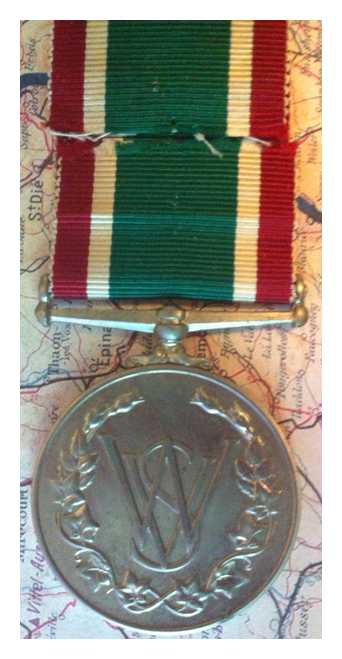
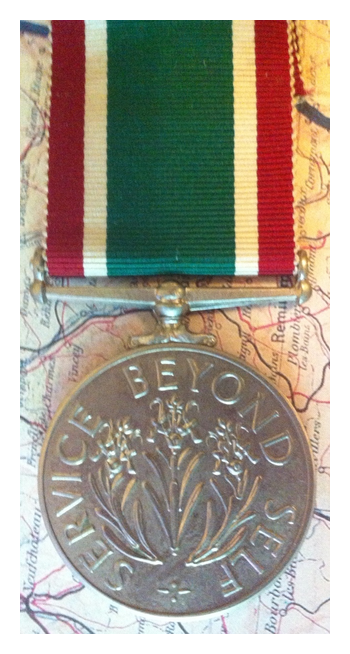
Flag_of_the_United_KingdomOn 16 May 1938, the British government set out the objectives of the Women’s Voluntary Service for Civil Defence. It was seen “as the enrolment of women for Air Raid Precaution Services of Local Authorities, to help to bring home to every household what air attack may mean, and to make known to every household [in the country] what it can do to protect itself and the community.”

In the words of the then Home Secretary, Sir Samuel Hoare, “as regards their civil defence functions, the Minister regards the Women’s Voluntary Service as occupying … much the same relationship as that of the women’s auxiliary services for the armed forces of the Crown.”

This medal was issued for 40 years of service to this organization.

rsz_wvs1 rsz_wvs2

The 1939-1945 War Medal with Mentioned in Dispatches Device

Posted in 1939-1945 Service Medals, Valour Medals with tags , , on February 14, 2010 by The Dude

Flag_of_the_United_KingdomThis medal is identical to my other British cupro-nickel War Medals with the exception of the mentioned in dispatches device which is affixed correctly to the ribbon. The nickel medals were issued to British and other Commonwealth troops with the exception of the Canadians who received a silver one.

rsz_ww2warmedal1 rsz_ww2warmedal2

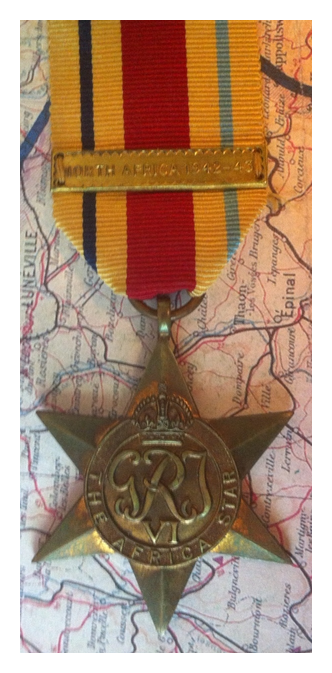
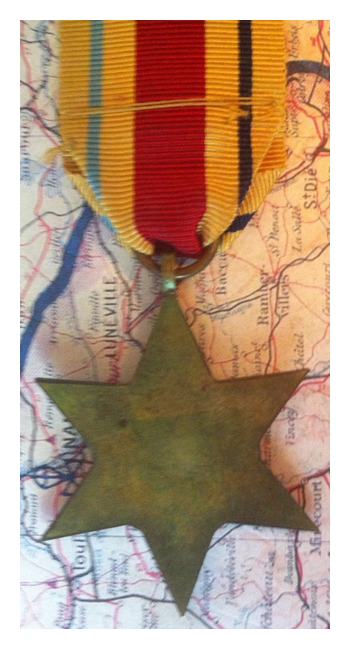
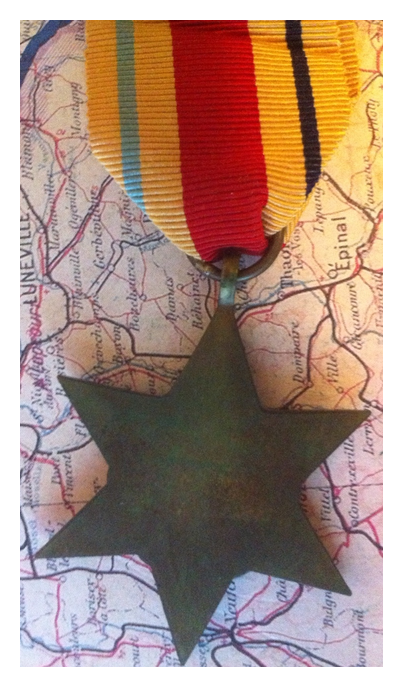
The Africa Star with North Africa 1942-1943 Bar

Posted in 1939-1945 Service Medals with tags , , on February 14, 2010 by The Dude

Flag_of_the_United_KingdomThe Africa Star was a campaign medal of the British Commonwealth, awarded for service in World War II.

The Star was awarded for a minimum one day service in an operational area of North Africa between 10 June 1940 and 12 May 1943.

The whole of the area between the Suez Canal and the Strait of Gibraltar is included, together with Malta, Abyssinia, Kenya, Sudan, The Solmalilands and Eritrea. The areas not bordering the Mediterranean only qualified for the Africa Star from 10 June 1940 to 27 November 1941.
Members of the Australian Imperial Force qualified for the Star for service in Syria from 8 June 1941 and 11 July 1941.

The example pictured includes the North Africa 1942-43 bar.

rsz_africastar1 rsz_africastar2

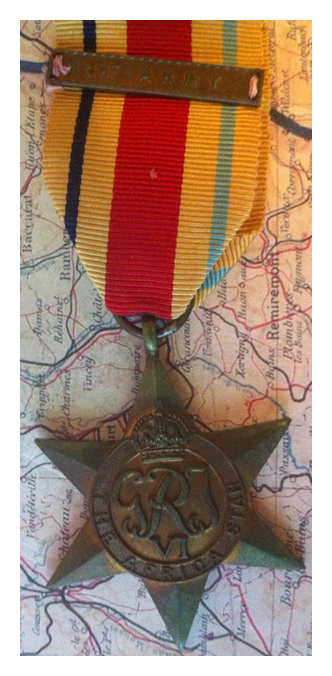
The Africa Star with 1st Army Bar

Posted in 1939-1945 Service Medals with tags , , on February 14, 2010 by The Dude

Flag_of_the_United_KingdomRegulations only allow one clasp to be worn with the Star, being the first clasp the recipient qualified for.

  • 8th Army
    Awarded for service with the 8th Army between 23 October 1942 and 12 May 1943. An ‘8’ is worn on the ribbon in undress to denote this bar. This award is controversial because Eighth Army was created in October of 1941 and fought in Africa for a year before the award service requirement. The award dates from the start of the El Alamein battle that ultimately led to the German eviction from Africa. Reportedly General Bernard Montgomery refused to allow Eighth
Army soliders who fought under his predecessor, General Auchinleck, from October of 1941, and even his first few months of service starting in August of 1942 to wear the award.
  • 1st Army
    Awarded for service with the 1st Army between 8 November 1942 and 12 May 1943. A ‘1’ is worn on the ribbon in undress to denote this bar.
  • North Africa 1942-43
    Awarded for service with the navy, merchant navy, or Royal Air Force in specified areas from 23 October 1942 to 12 May 1943. In undress, a rosette on the ribbon denotes this bar.
  • Use of rosette emblem
    During the same dates, inshore service by the merchant navy, certain commands of the Royal Air Force and by the personnel of the headquarters of the 18th Army Group earned a silver rose emblem instead of one of the clasps.

The example here is one with a 1st Army bar.

rsz_africa1st1 rsz_africa1st2

The Africa Star with 8th Army Bar

Posted in 1939-1945 Service Medals with tags , , on February 14, 2010 by The Dude

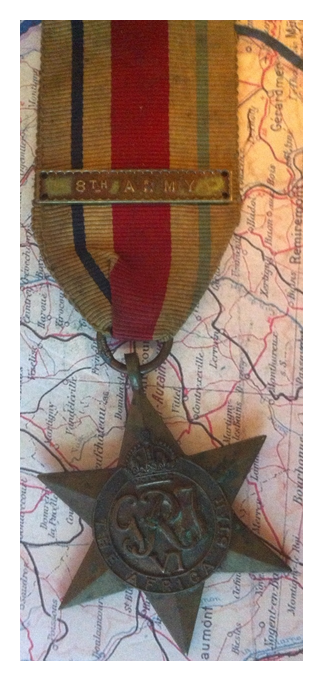
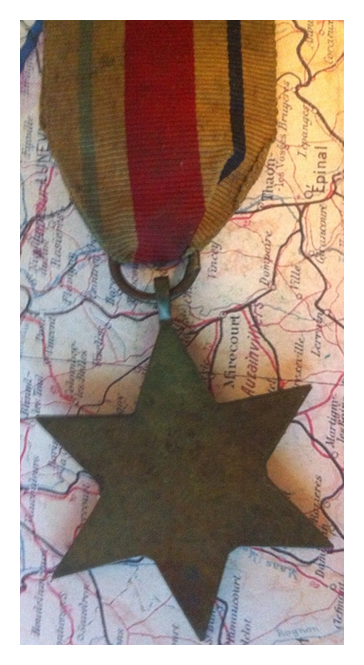
Flag_of_the_United_KingdomThis example of the Africa Star has an additional 8th Army bar attached. See above for other examples. I have a few more Africa Stars, in groups mostly and a single without any bar.

rsz_africa8th1 rsz_africa8th2

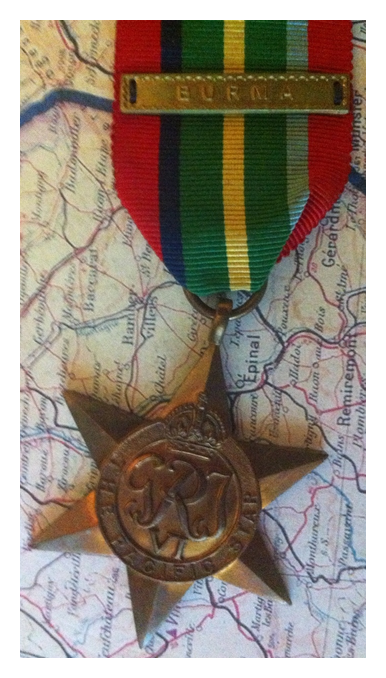
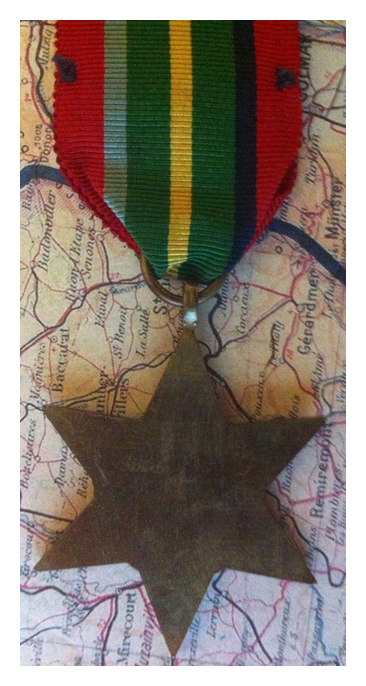
The Pacific Star with Burma Star Clasp

Posted in 1939-1945 Service Medals with tags , on February 14, 2010 by The Dude

Flag_of_the_United_KingdomThis is one of my favourite of the stars from WW2. This is because it is part of my grandfathers entitlement as he fought in the Solomon Islands against the Japanese.

The medal was awarded for operational service in the Pacific Theater between 8 December 1941 and 2 September 1945, and also for certain specified service in China, Hong-Kong, Malaya and Sumatra:

Hong Kong – between 8 December 1941 and 25 December 1941
China and Malaya – between 8 December 1941 and 15 February 1942
Sumatra – between 8 December 1941 and 23 March 1942
Second World War service in China, Hong Kong, Malaya and Sumatra after the above end dates was recognised by the award of the Burma Star.
The qualifying sea areas for the award of the Pacific Star are the Pacific Ocean (including the South China Sea) and the Indian Ocean east of a line running due south from Singapore round the South-East coast of Sumatra, through Christmas Island, and southwards along the meridian of 110 deg East.
The Pacific Star was authorized for immediate bestowal to any soldier or sailor who had been killed or wounded in combat.
British uniform regulations stipulated that Burma Star would not be awarded to a recipient of the Pacific Star. Subsequent entitlement to the Burma Star was denoted by the award of the Burma Star clasp.

rsz_pacstar1 rsz_pacstar2

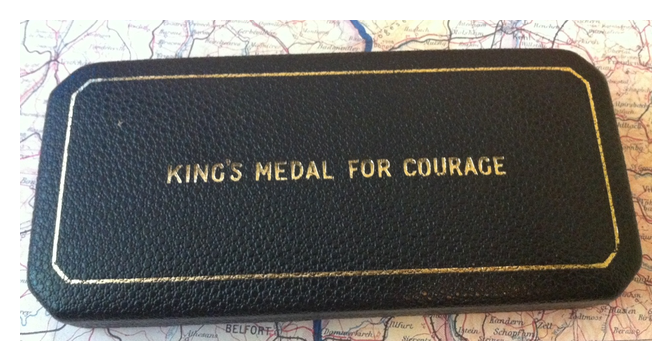
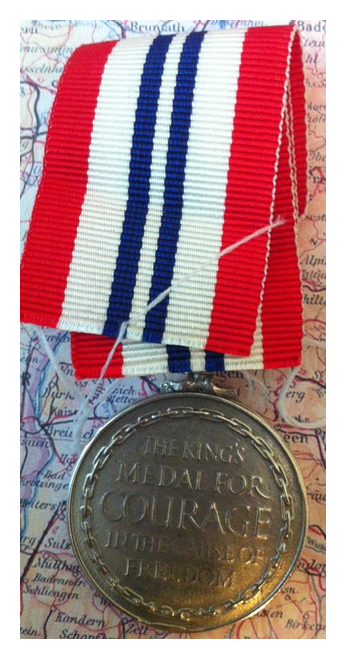
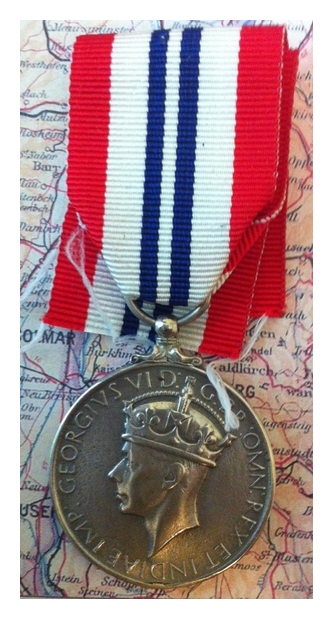
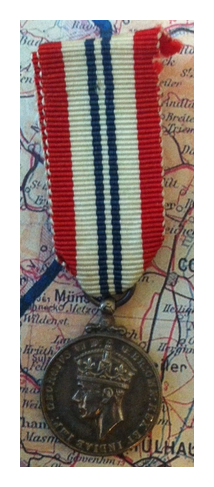
The King’s Medal for Courage in the Cause of Freedom with Miniature & Case

Posted in Rare Medals, Valour Medals with tags , , on February 14, 2010 by The Dude

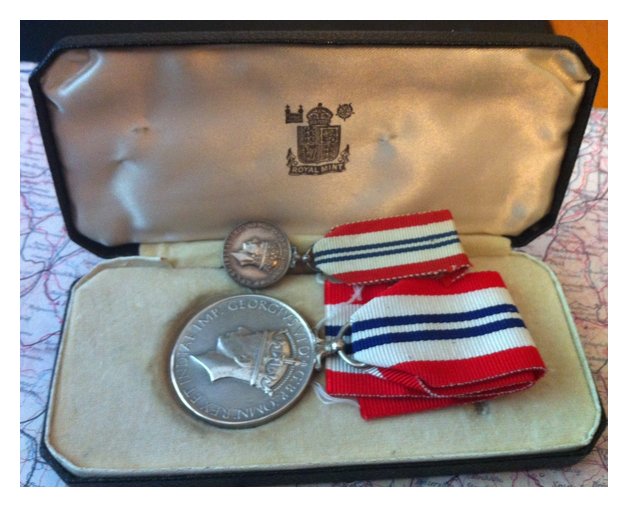
Flag_of_the_United_KingdomThe King’s medal was issued in two versions: The King’s Medal for Courage in the Cause of Freedom and the King’s Medal for Service in the Cause of Freedom. Both medals were silver and 36 millimetres in diameter.

The King’s Medal for Courage in the Cause of Freedom was introduced on 23 August 1945, to mark the acts of courage by foreign civilians in the furtherance of the British Commonwealth in the Allied cause. It was primarily intended to reward those foreign civilians who had assisted British escapees in enemy occupied territory. The medal’s obverse has the crowned profile of King George VI, with the text “The King’s Medal for Courage in the Cause of Freedom” on the reverse. The medal’s ribbon was white with two narrow blue stripes in the centre and two broad red stripes at the ribbon’s edges.

There are a number of fakes of this medal in circulation, all cast from the same original. Look for an edge bruise at 5:30 on the medal and avoid if you see it.

My example came with some Free French membership badges which were numbered, offering me an opportunity to research and discover the recipient. Excellent.

rsz_kingsmedal3 rsz_kingsmedal4 rsz_kingsmedal5 rsz_kingsmedal7
rsz_kingsmedal2rsz_kingsmedal8

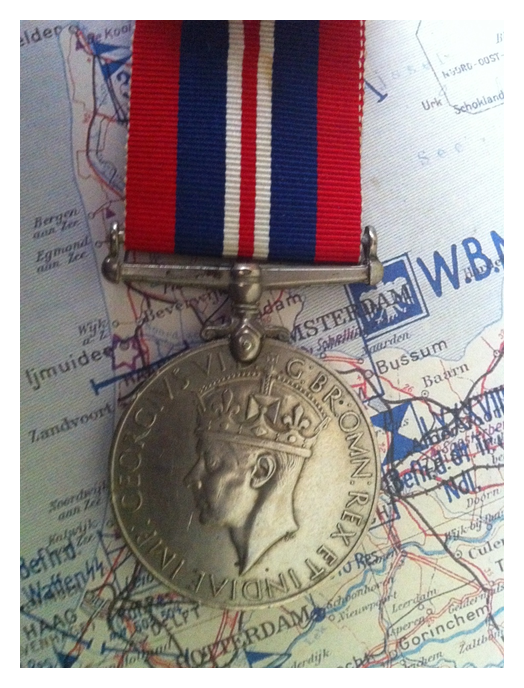
The 1939-1945 War Medal

Posted in 1939-1945 Service Medals with tags , on February 14, 2010 by The Dude

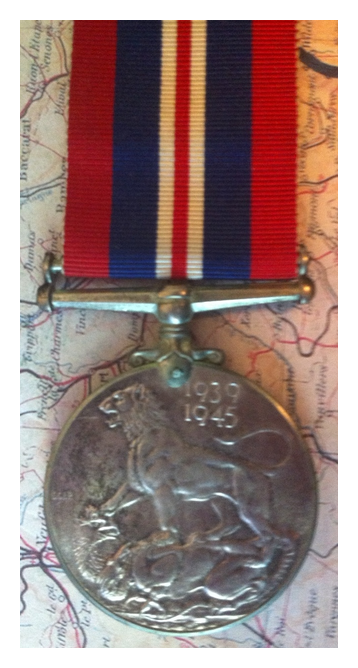
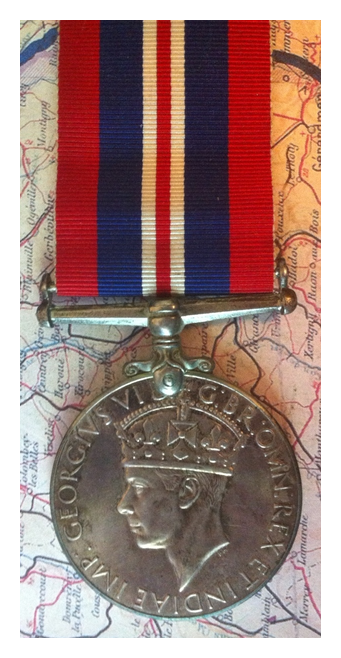
Flag_of_the_United_KingdomThe War Medal 1939–1945 was a British decoration awarded to those who had served in the Armed Forces or Merchant Navy full-time for at least 28 days between 3 September 1939 and 2 September 1945.

In the Merchant Navy, the 28 days must have been served at sea.

It is sometimes described as the “Victory Medal” for World War II, although that is not its correct name. Generally these things are unnamed but I have a one orphan that is named.

For those of you hunting down sets it is as follows, 1220764 N.K. Mohd AJAIB.

I otherwise have a trunkful of these.

rsz_45victory2 rsz_45victory1

rsz_ww2warmedal3 rsz_ww2warmedal4

1939-1945 Star

Posted in 1939-1945 Service Medals with tags , on February 14, 2010 by The Dude

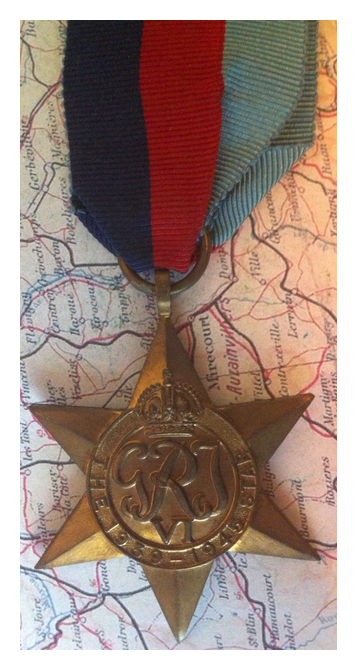
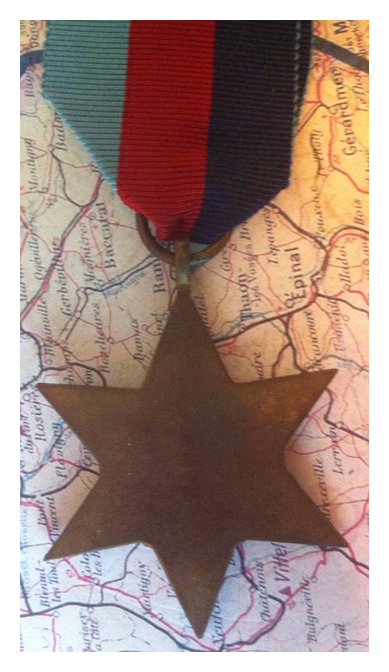
Flag_of_the_United_KingdomThe 1939–45 Star was a campaign medal of the British Commonwealth, awarded for service in the Second World War. The medal was awarded for operational service between 3 September 1939 and 2 September 1945.

Army personnel had to complete 6 months service in an operational command. Airborne troops qualified if they had participated in any airborne operations and had completed 2 months service in a fully operational unit.
Air Force personnel had to participate in operations against the enemy providing that 2 months service had been completed in an operational unit. Non-aircrew personnel had to complete 6 months service in an area of (overseas) operational army command.
Naval personnel qualified if they completed 6 months service, and at least 1 voyage was made through an operational area.
Royal Observer Corps personnel for service of 1080 days.

There were a number of “Qualifying Special Areas” where operational service for “one day or part thereof” qualified for the special award of the 1939–45 Star. These were actions for which a more specific campaign medal was not issued. Examples are: France or Belgium: 10 May to 19 June 1940, St.Nazaire 22-28 March1942, Dieppe: 19 August 1942, Iraq: 10 April to 25 May 1941 and Burma (Enemy Invasion): 22 February 1942 to 15 May 1942.[1] The star was immediately awarded if the service period was terminated by death, disability or wounding. The award of a gallantry medal or a Mention in Despatches also led to an immediate award.

I have a few of these medals.

rsz_193945star

rsz_3945star1 rsz_3945star2

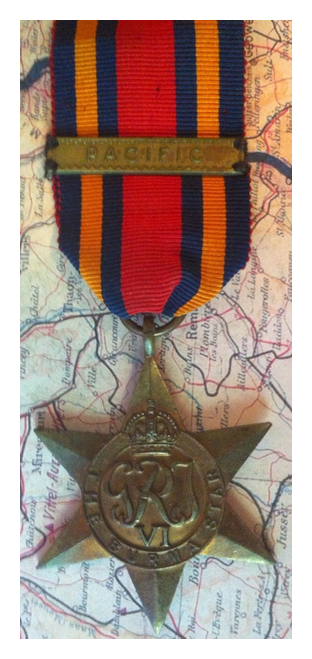
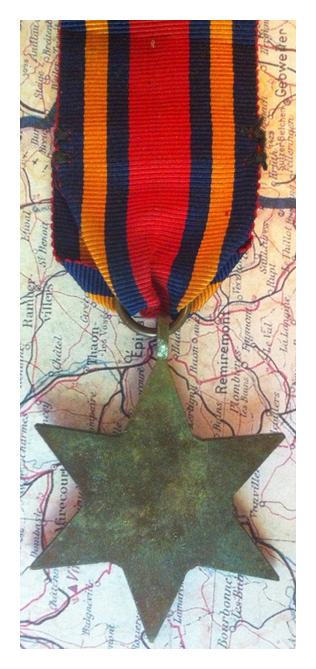
The Burma Star with Pacific Bar

Posted in 1939-1945 Service Medals with tags , , , , , on February 14, 2010 by The Dude

Flag_of_the_United_KingdomThe Burma Star was a campaign medal of the British Commonwealth, awarded for service in World War II.

The medal was awarded for service in the Burma Campaign between 11 December 1941 and 2 September 1945. This medal was also awarded for certain specified service in China, Hong Kong, Malaya and Sumatra:

  • Hong Kong – between 26 December 1941 and 2 September 1945
  • China and Malaya – between 16 February 1942 and 2 September 1945
  • Sumatra – between 24 March 1942 and 2 September 1945
  • Second World War service in China, Hong Kong, Malaya and Sumatra after 8 December 1941 but prior to the above start dates was recognised by the award of the Pacific Star.

British uniform regulations stipulated that the Pacific Star would not be awarded to a prior recipient of the Burma Star. Subsequent entitlement to the Pacific Star was denoted by the award of the Pacific clasp.

rsz_burmaandpac1 rsz_burmaandpac2

1914-15 Star

Posted in 1914-1918 Service Medals with tags , on December 21, 2009 by The Dude

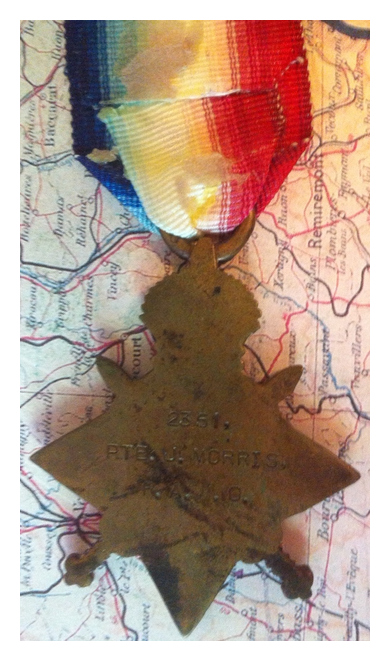
Flag_of_the_United_KingdomThe 1914-15 Star was a campaign medal of the British Empire, for service in World War I.

The 1914-15 Star was approved in 1918, for issue to officers and men of British and Imperial forces who served in any theatre of the War between 5 August 1914 and 31 December 1915 (other than those who had already qualified for the 1914 Star).
Recipients of this medal also received the British War Medal and Victory Medal. Some 2,366,000 were issued, including: 283,500 to the Royal Navy & 71,150 to Canadians.

I have a few of these in groups but also one orphan, 9078 Spr. L.Edmunds R.E.

rsz_1914151 rsz_1914152

A Birchall Group from the Crimean War

Posted in 1850-1900 Medals, Family Groups & Singles with tags , , , on December 5, 2009 by The Dude

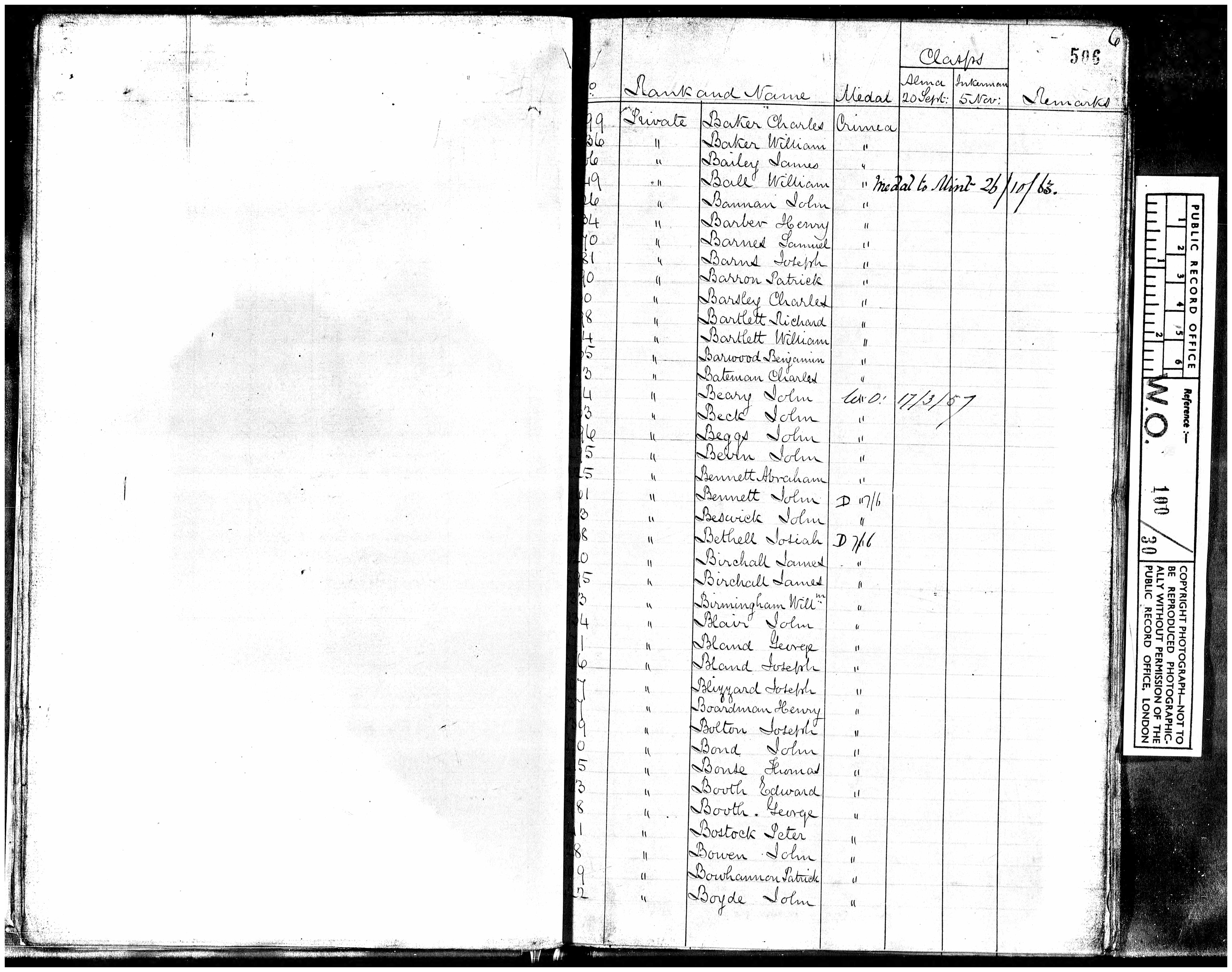
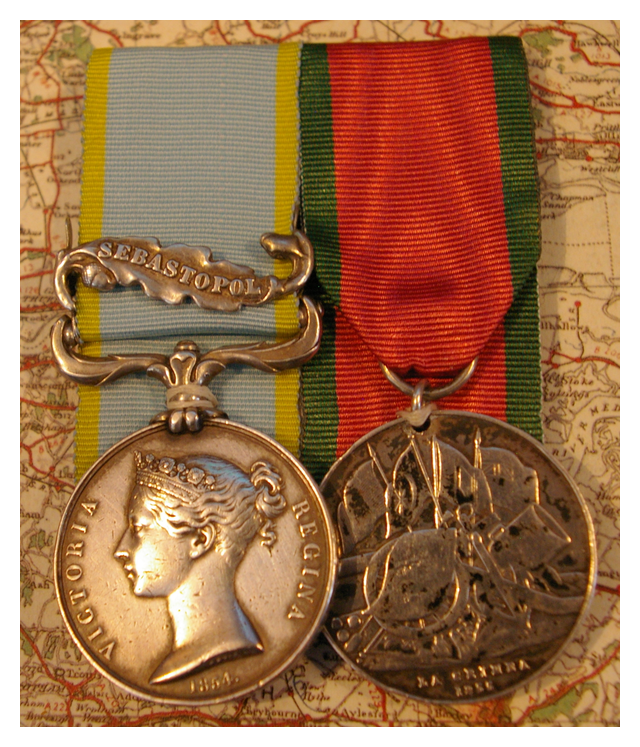
Flag_of_the_United_KingdomHere is one of my family groups, the earliest one I have, comprising the Crimean War Campaign medal with the Sevastopol Bar impressed to J.Birchall, 56th Regiment. The accompanying Turkish Crimean Medal is a Sardinian example and is unnamed.

The Crimea Medal was a campaign medal approved in 1854, for issue to officers and men of British units (land and naval) which fought in the Crimean War of 1854-56 against Russia.

The medal is notable for its extremely ornate clasps, being in the form of an oak leaf with an acorn at each extremity, a style never again used on a British medal. The suspension is an ornate floriated swivelling suspender, again unique to the Crimea Medal.

Five bars were authorised, the maximum awarded to one man was four. The medal was issued without a clasp to those who were present in the Crimea, but not present at any of the qualifying actions. A five bar specimen is held in the Royal Collection.

This medal was also presented to certain members of allied French forces. These medals, in addition to the five British clasps, were often issued with unauthorised French bars; Traktir, Tchernaia, Mer d’Azoff, and Malakof.

The medal was awarded with the British version of the Turkish Crimean War medal, but when a consignment of these were lost at sea some troops were issued with the Sardinian version instead.

rsz_56thfootmedalroll

rsz_imgp6195

New Zealand War Service Medal

Posted in 1939-1945 Service Medals with tags , on December 4, 2009 by The Dude

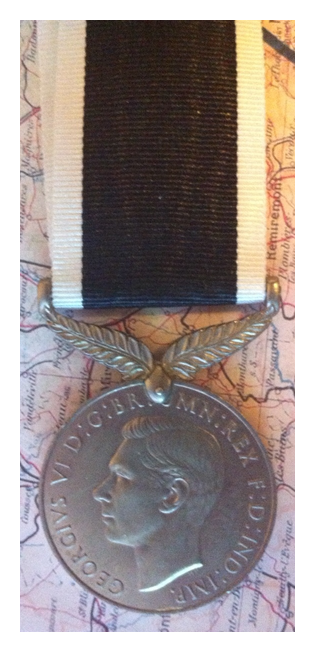
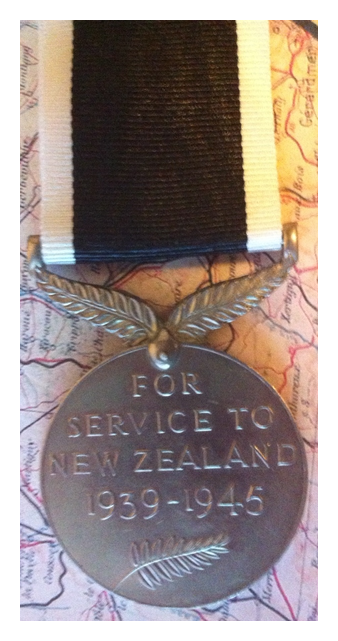
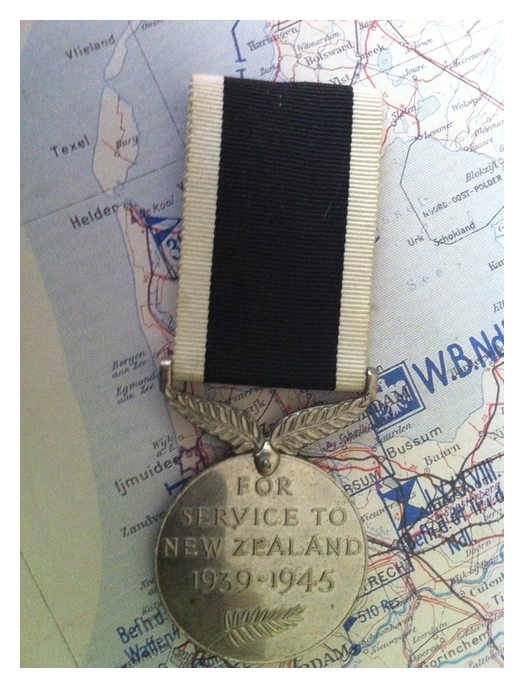
Flag_of_New_ZealandThis medal was awarded for one month’s full time service or six months’ part time service in any of the Armed Services, the Reserve or Home Guard between 3 September 1939 and 2 September 1945. This medal was the first distinctively ‘New Zealand’ campaign medal, which was emphasised by the use of the fern leaf motif on the reverse and the national colours of black and white in the ribbon.

The New Zealand War Service Medal was issued unengraved, as were other Second World War campaign medals awarded for service for New Zealand.

Being a New Zealander I am especially fond of this medal. My grandfathers medal bar contains one as does the one belonging to the Grand-Uncle that I am named after. I have two examples of this medal.

rsz_nzwarmedal1 rsz_nzwarmedal2rsz_warsericenz3

rsz_warsericenz2

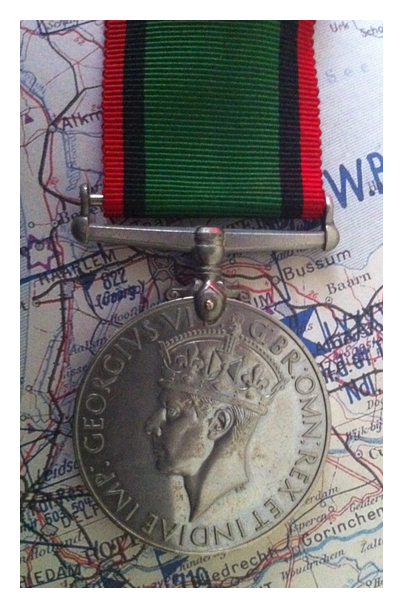
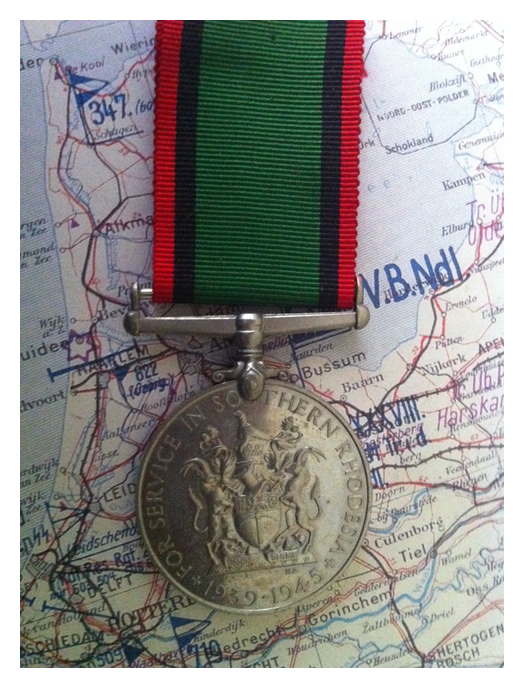
Southern Rhodesia Medal for War Service

Posted in 1939-1945 Service Medals with tags , on November 28, 2009 by The Dude

800px-Flag_of_Southern_RhodesiaInstituted in 1946 and only issued 1700 times.

This is the second rarest Commonwealth service medal to get hold of since the Rhodesians were not allowed to operate as a separate unit. Most of them were either drawn into South Africa units or British formations. If the former, then they were usually awarded the Africa Service Medal.

This medal was only awarded to those Rhodesians who were not eligible for any other stars or service medals. I have only seen a handful of these since I started collecting a decade ago. The most interesting was in a group with the BWM and Victory Medal for some bloke who had served in East Africa in the Great War and then did home service in WW2.

rsz_rhodesiaww21 rsz_rhodesiaww22